

How Schools Use Tarpaulins as Affordable Learning Tools
 Schools often work with tight budgets. That constraint affects everything, from classroom supplies to teaching materials. Because of this, teachers and administrators look for options that are durable, reusable, and cost-effective. One material that has proven useful over time is the tarpaulin.
At first glance, tarpaulins are not designed for education. They are commonly used for outdoor covers, banners, or temporary shelters. But in many schools, especially in resource-limited areas, they have become a practical learning tool. Their strength, flexibility, and low maintenance make them a reliable alternative to traditional materials, whether schools source them locally or choose to buy a tarpaulin for specific classroom needs.
Durable Visual Aids That Last
One of the most common uses of tarpaulins in schools is for visual aids. Teachers print lesson content directly onto the material. These include alphabet charts, number lines, multiplication tables, world maps, and science diagrams.
Unlike paper posters, tarpaulins do not tear easily. They can withstand frequent handling and are not damaged by moisture. Teachers can roll them up after use and store them without worrying about creases or rips. This makes them a long-term investment rather than a short-term fix.
Over time, this durability leads to savings. Schools do not need to replace teaching charts as often. That reduces recurring costs and helps stretch limited funds further.
Useful for Indoor and Outdoor Learning
Not all schools have enough classroom space. In some cases, classes are held outdoors or in shared areas. Traditional materials like paper or cardboard are not suitable in these conditions. They wear out quickly when exposed to wind, dust, or rain.
Tarpaulins solve this problem. They can be used both indoors and outdoors without much risk of damage. Teachers can hang them on walls, fences, or makeshift boards. They can also be laid flat on the ground for group activities.
This flexibility allows schools to conduct lessons almost anywhere. It also supports alternative teaching setups, especially in overcrowded or under-resourced environments.
Supporting Interactive Learning
Tarpaulins are not limited to passive display. They can also support interactive learning. Some are designed with surfaces that allow writing using whiteboard markers. Students can write answers, solve math problems, or draw diagrams directly on them.
After each activity, the surface can be wiped clean and reused. This turns a single tarpaulin into a reusable workspace. It also reduces the need for paper worksheets, which can add up in cost over time. Interactive use encourages participation. Students are more likely to engage when they can physically interact with the material rather than just look at it.
Making Learning More Engaging Through Play
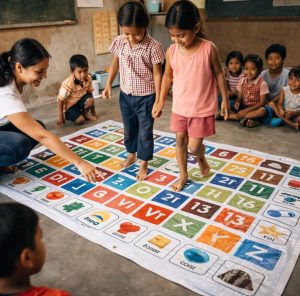
Younger students benefit from activity-based learning. Tarpaulins can be designed as large floor mats with printed letters, numbers, shapes, or even game boards. These can be used for educational games that involve movement. For example, a teacher might ask students to step on the correct answer to a math problem. Or they might jump between letters to form words. These activities make lessons more engaging and help reinforce concepts through physical interaction.
This approach does not require expensive equipment. A single well-designed tarpaulin can support multiple types of games and activities.
Cost Efficiency Over Time
At first, printing on tarpaulin may seem more expensive than printing on paper. But the long-term value is higher. Paper materials often require lamination to last longer, which adds to costs. Even then, they still wear out relatively quickly. Tarpaulins do not require lamination. They are already resistant to water and wear. Because they last longer, the cost per use declines over time.
Schools can also standardize designs. For example, general-purpose tarpaulins can be reused across different classes or school years. This reduces the need to produce new materials regularly.
Flexible Use Beyond the Classroom
Tarpaulins are not limited to teaching. Schools also use them for events, announcements, and displays. Instead of printing new banners for every event, schools can design reusable tarpaulins with interchangeable sections. For example, a school program banner can have fixed elements and replaceable parts for dates or themes. This reduces waste and saves money.
In addition, tarpaulins can serve practical purposes during emergencies. In areas prone to natural disasters, schools often become evacuation centers. Tarpaulins can be used as temporary partitions, shelter covers, or ground sheets. Afterward, they can return to classroom use.
Easy Maintenance and Hygiene
Keeping materials clean is important, especially in classrooms with young children. Tarpaulins are easy to maintain. This makes them more hygienic than paper-based materials, which are harder to clean. In environments where dust and humidity are common, this is a clear advantage. Their resistance to moisture also prevents mold and other damage, a common issue with paper charts stored in less-controlled conditions.
Limitations and Considerations
Despite their benefits, tarpaulins are not without drawbacks. Large tarpaulins can be bulky and may require adequate storage space. Rolling and organizing them properly is necessary to avoid clutter.
Print quality is another concern. Low-quality prints may fade over time, especially when exposed to sunlight. Schools need to choose reliable printing services to ensure durability.
There is also the issue of environmental impact. Most tarpaulins are made from plastic-based materials. While they reduce paper waste, they are not always easy to recycle. Some schools address this by extending their use for as long as possible or repurposing old tarpaulins for other functions.
The Role of Teachers in Maximizing Use
A tarpaulin is only as effective as how it is used. A well-designed tarpaulin can support different teaching strategies, but it requires thoughtful planning. Teachers who use them creatively can turn simple visuals into interactive tools. They can adapt activities based on student needs and make lessons more engaging without additional cost.
This shows that innovation in education does not always depend on advanced technology. Sometimes, it comes from making better use of available resources.
A Simple but Effective Solution
The use of tarpaulins in schools reflects a practical approach to education. It focuses on durability, flexibility, and cost efficiency. While they are not perfect, they offer a reliable solution for many common challenges.
In many cases, simple tools like tarpaulins make a real difference. They help schools provide consistent learning materials, support interactive teaching, and manage limited budgets more effectively.